-
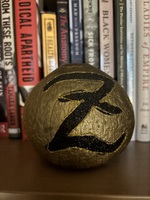 Zulu Coconut
 This was a coconut caught in the 2016 (?) Zulu Social Aid & Pleasure Club Parade, the first parade on Fat Tuesday during Mardi Gras. Zulu is the oldest Black Mardi Gras Krewe, and they deliberately play with stereotypes of Blackness and African American identity through their attire, use of Blackface, and their iconic “throw”, the Zulu Coconut. This specific coconut (each are unique) is painted gold, with the Z symbol in Black bordered with glitter. The Zulu coconut represents a broader story of integrating previously exclusionary public celebrations and forcefully changing their iconography.
-
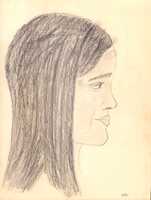 Portrait of an artist as a young woman
 Portrait of an artist as a young woman.
-
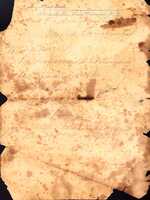 Raised Doughnut Recipe By Mrs. Alfonso Smith
 Handwritten recipe of Clara Smith - sharing her doughnut recipe.
-
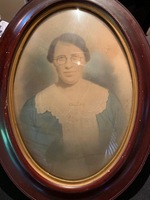 Portrait of Cora Houston Smith
 Family portrait of Cora Houston Smith.
-
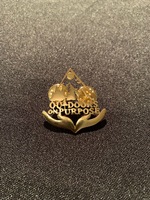 Outdoors on Purpose Lapel Pin
 An image that displays unity, outdoors, connections, purpose and defines how purposely Black people are outdoors.
-
 Family Outing
-
 Annotations?
-
 Membership Letter, F. Bleax, Pastor
 Recommendation Letter for Deacon Ebenezer Williams. The Deacon's pastor, Pastor Bleax, writes a letter of support summarizing his character, service and contribution to Westbury African Methodist Episcopal Zion Church of Westbury, Long Island, NY. Though not specifically stated, it is believed that the intended recipient of the letter would have been in church leadership at Mother Bethel African Methodist Episcopal Church in Philadelphia, PA.
-
 Marriage certificate, [Washington C. Young to Amanda L. West]
 This marriage certificate for Washington Craig Young (January 2, 1860-November 2, 1931) and Amanda L. (West) Young (June 20, 1860-January 20, 1943) features two bust-length, carte-de-visite studio portrait photographs, gold touches, pictorial details, an ornate border, and text.
-
 Letter, Rebecca Johnson to Miss Anderson, May 19, 1945
 This letter was sent by Miss Rebecca Mary Johnson (July 10, 1905-October 4, 1991) to Miss Marian Anderson (February 27, 1897-April 8, 1993) on May 19, 1945. This letter was sent to share details about “a project for… intercultural advancement” that will feature famous Black Americans, like Marian Anderson (p. 1). Johnson asks Anderson questions about herself to be used in the exhibit for the benefit of the Springfield, Massachusetts community and youth.
-
 Letter with envelope by Garland Fields Sr. to Emeline Gillette.
 Garland Fields Sr. (1897 - 1974) was the grandfather of Beverly Mills's (b. 1960) Mills is one of the co-founders of the Stoutsburg Sourland African American Museum with Elaine Buck. The two co-authored the books noted below.
This first of two love letters describes their courtship and Fields' strong feelings for Emeline, who ultimately did not marry him.
-
 [Harry Nelson in front of his Doylestown barber shop]
 On the reverse of this photography is written "Harry Nelson Doylestown/Barber." This black and white photograph shows Nelson standing outside of a store.
-
 Lancaster Productions International press release for Byard Lancaster
 This press release invites the public to gather in support of and celebrate the birthday of Mrs. Mattie Humphrey, also known as “Sister Majida,” at Morgan’s Jazz Club located at 17 East Price Street in Germantown, Philadelphia.
-
 Keep Us Flying poster
 Poster created by the U.S. Treasury Department during World War II to encourage war bond purchase.
-
 Correspondence for James E. Adams
 This letter was sent to the Meet The Composter/New Residencies group at 2112 Broadway, Suite 505 in New York City, NY by Artistic Manager and President of The Philadelphia Clef Club of the Performing Arts, Inc. James E. Adams on October 15, 1992.
-
 Correspondence for Bill Leslie
 Bill Leslie’s urgent letter to members of the Philadelphia Clef Club of Jazz and Performing Arts provides a slight glimpse into the finances of the Clef Club at a specific period of time.
-
 James E. Adams's Business Card
 .James E. Adams was the first President of the Philadelphia Clef Club when it was formed in 1966. The Clef Club was founded as a social club within the Musicians’ Protective Union Local 274, American Federation of Musicians (AFM), of which Adams was also the President.
-
 American Federation of Musicians application
 This application for the American Federation of Musicians Local No. 274 was submitted by Byard Lancaster on March 5, 1966 and signed by secretary Frank T. Fairfax.
-
 John W. Coltrane dues record
 A 2-page balance sheet of union dues from legendary jazz saxophonist, composer, and band leader John William Coltrane (1926-1967). The dues are for local chapters of the American Federation of Musicians (AFM) of which John Coltrane was a member–Local 802 serving New York and Local 274 for Philadelphia.
-
 The Philadelphia Cotillion Society presents The Dra-Mu Opera Company in "Carmen"
 The Dra-Mu Opera Company, "Dra-Mu", was a significant Black opera company in Philadelphia, active during the mid-20th century. Co-founded by Raymond L. Smith and Henri Elkan (Van Atta, “Henri Elkan, Music Publisher, Conductor: Obituary.”), the company provided a platform for Black artists to perform operatic works at a time when opportunities in mainstream opera were limited due to racial discrimination.
The Philadelphia Cotillion Society was the oldest Black cotillion organization in the United States. (New York Times, “Philadelphia Cotillion Society Will Celebrate Here Tonight.”) The Philadelphia Cotillion Society played a significant role in the city's cultural and social landscape. It provided a platform for young Black women to be formally introduced to society, celebrating their achievements and fostering community pride.
A "cotillion" is a formal ball at which debutantes are presented.
-
 Letter, Ronia Barmas to the greatest singer, April 17, 1951
 This letter was sent by Ronia Barnas presumably of Brooklyn, New York to Marian Anderson (February 27, 1897-April 8, 1993) on April 17th, 1951. The letter was written to complement Anderson on the remarkable beauty of her voice that reaches “never before reached heights” (p. 2). Signing the letter off as Anderson’s “admirer,” Barnas expresses her desire to hear her in person and say: “‘You Marian Anderson - are the greatest singer of them all.’”
-
 Letter, William J. Goggans to Miss Anderson, January 26, 1957
 A typed letter from then soldier, educator, and musician William James Goggans (1933-2003) to globally renowned contralto Marian Anderson Fisher (1897-1993). In his letter, Goggans expresses his admiration for Marian Anderson. He congratulates her for being selected as one of the 10 most admired women in the world and asks her to inform him if she plans to perform in the Washington, D.C. area in the near future.
-
 Letter, John Hassett to Marian Anderson, December 31, 1957
 Little is known about John Hassett, the person. The letter was written on proprietor’s stationery for a South Norwalk, Connecticut retail shop.
-
 Letter, Helen Good to Marian Anderson, December 20, 1957
 This letter was sent by Helen Marie Good (March 15, 1939-) of Elkhart, Indiana to Marian Anderson (February 27, 1897-April 8, 1993) on April 17th, 1951. The letter was written by Good to introduce herself to Anderson, and to express her and her mother’s excitement to see her in concert at Goshen College in the summer of 1957.
-
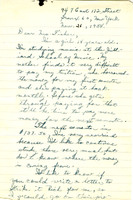 Letter, Kathleen Brown to Miss Fisher, November 26, 1954
 A two-page, handwritten letter from music student Kathleen Brown to globally renowned contralto Marian Anderson (1897-1993). In the letter, Brown describes financial constraints in paying for her tuition at Juilliard School of Music. She asks for Marian Anderson to write a letter to the radio game show “Strike It Rich.”
-
 Letter, Charlie Hall Jr. to Marian Anderson, May 5, 1939
 A letter from Charlie Hall Jr., a 16-year-old African American farmer and 10th-grade student from Lawndale, North Carolina, to singer Marian Anderson, dated May 5, 1939. Written shortly after Anderson’s historic Easter concert at the Lincoln Memorial on April 9, 1939, the letter conveys Hall’s admiration for her artistry and resilience, as well as parallels to his own life. Weeks earlier, Charlie had heard Anderson’s voice and called it “beautiful”.
-
 Letter, Mary Emma Jones to Miss Anderson, 1945
 This letter was sent by Mary Emma Jones (1928-) of Trappe, Collegeville, Pennsylvania to Marian Anderson (February 27, 1897-April 8, 1993) in 1945, presumably towards the end of Mary’s junior year at Collegeville Trappe High School. The purpose of this letter is to request compelling information from Anderson so that her junior year term paper would be impressive, and make her parents proud (page 2). Jones repeatedly offers compliments, gratitude, and appreciation to Anderson. She notes that she has attended Anderson’s concerts in Philadelphia, which would be about an hour (roughly 32 miles) from Collegeville, PA.
-
 Letter, Cheryl G. Jones to Miss Anderson, August 27, 1969
 An envelope, two-page letter, and signed photograph mailed by high school student and aspiring singer Cheryl G. Jones to globally renowned contralto Marian Anderson Fisher (1897-1993). The letter is among many letters from aspiring singers and musicians included in the Marian Anderson Papers. Anderson's life was an inspiration to them and to countless others in the United States and abroad (Kruesi 1998).
-
 Letter, Jane Frink to Marian Anderson, September 9, 1974
 Hoosier Jane Frink was an avid singer in high school and college. She garnered numerous awards and medals, according to print media accounts (The Terre Haute Tribune, “List Junior, Senior High School Music Winners - Jane Fink.”) (The Terre Haute Tribune, “Letter, Jane Frank to Miss Marian, September 9, 1974.”).
-
 Letter, Barlana Bates to Miss Anderson
 This letter was sent by Barlana Bates (c. 1942) to Marian Anderson (February 27, 1897-April 8, 1993) sometime after December 30th, 1957. The letter appears to have been drawn on tracing paper. The front of the card is very colorful, with an illustration drawn with crayon of two people in parkas above an American flag, and below text that reads “A Salute to Alaska!”
-
 Letter, Marilyn Bazick to Miss Anderson, January 16, 1958
 A handmade card to globally renowned contralto Marian Anderson Fisher (1897-1993) from a student named Marilyn Bazick. The card’s letter is written in blue ink in two separate handwritings. Colorful stars and flower shapes drawn in crayon decorate the card. The letter is among many letters from students, aspiring singers and musicians included in the Marian Anderson Papers. Anderson's life was an inspiration to them and to countless others in the United States and abroad (Kruesi 1998).
-
 Letter, Mary Helen Stanek to Marian Anderson, February 21, 1952
 Mary Helen Stanek, age 10, of Lehigh, Iowa, sent a birthday card and brief letter to Marian Anderson, dated February 21, 1952. Stanek writes to wish Anderson “years and years of happiness” upon discovering they share the same birthday, February 27th.
-
 Letter, Dutch Barhydt to Marian Anderson, May 16,1971
 Thirteen-year-old Dutch Barhydt wrote to Anderson that he is a dedicated autograph collector. His objective is collecting original signatures from famous and influential people, including presidents and prime ministers. The teenager successfully acquired Miss Anderson’s signature.
-
 The diary of Sallie Sanders Venning (1890)
 The diary presented here is the first of three diaries written by Sallie Sanders Venning between 1890-1892.
Sarah Sanders Venning, known as Sallie, was born in Philadelphia on March (or August)13, 1872. She was the daughter of Julia Sanders and Edward Y. Venning. She was a substitute teacher during the time the diary was kept. She married William B. Holden in 1903 and was widowed in 1928. She was active in St. Thomas African Episcopal Church and in various women's clubs. She died in 1959.
-
 Cogdell, Mary Ann Elizabeth Stevens: Watercolor with poem by Cordelia Sanders on back
 The front page features a hand-painted watercolor bird on a tree, signed by Mary Ann Elizabeth Cogdell. The reverse side features a poem written in cursive about truth signed by Cordelia Sanders circa 1840.
-
 Frederick Douglass Memorial Hospital and Training School charter and certificate of incorporation
 This charter and certificate of incorporation legitimized the Frederick Douglass Memorial Hospital and Training School in Philadelphia on April 10, 1896. The charter includes the hospital and school’s purpose, leadership, and articles and conditions. The Frederick Douglass Memorial Hospital and Training School was a Black owned and operated institution existing to serve the Black community (National Library of Medicine, n.d.).
-
 First Annual Report of the Board of Managers of the Frederick Douglass Memorial Hospital and Training School, 1512 Lombard Street Philadelphia 1896
 Founded in 1895 by Dr. Nathan F. Mossell (1856 - 1946), the Frederick Douglass Memorial Hospital and Training School was the first Black owned and operated healthcare institution in the country (Bates, Bargaining for Life).
-
 Reducing and Body Building, Don Blackman, Physical Culture Studios
 This leaflet serves as an advertisement for Don Blackman's exercise studio.
-
 Laura and Frank Brashears, stereoscopic photo
 This glossy black and white photo reveals Laura and Frank Brashears with a caption: "under the shade of the old apple tree.” The photo was taken August 12, 1906 likely in or around Doylestown, PA.
-
 [Dinner at the Myers home in Levittown]
 This item is a black and white photograph of William Myers (1922?-1987) and Daisy Myers (1925-2011) having dinner in their Levittown home. The couple are dressed in casual attire as William sits at the table while Daisy pours him coffee.
When Levittown was first created, the housing agreements included racist policies barring people of color from living in the community. The Myers family became the first Black family to move into the 15,000 home all-White Levittown community in Bristol Township, Bucks County. They to 43 Deepgreen Lane in Levittown in August 1957, having purchased the house from a Jewish couple.
-
 [William Myers, Jr. and Daisy Myers sitting at home]
 This item is a black and white press photograph of William Myers, Jr. (1922?-1987) and Daisy Myers (1925-2011) sitting together on a couch.
When Levittown was first developed, the housing agreements included racist policies barring people of color from living in the community. The Myers became the first Black family to move into the 15,000 home all-White Levittown community in Bristol Township. They moved to 43 Deepgreen Lane in Levittown in August 1957, having purchased the Levittown home from a Jewish couple.
The move had only been the distance of one mile but the Myers’ family new address lead to months of protests and threats from White local citizens. Eventually, with the aid of police and media coverage the protests stopped. The Myers remained in their Levittown home for four years.
-
 Will of Jeremiah Langhorne
 Jeremiah Langhorne (d. 1742) of Middletown, Bucks County, Pennsylvania, set forth his last will and testament in May 1742. His primary estate, an 800-acre plantation known as Langhorne Park, is devised to his grand-nephew Thomas Biles, with provisions for heirs of his body, and in default, to his niece Sarah Growdon and her heirs, then to her husband Lawrence Growdon.
He carefully stipulates that three enslaved men—Jo, Cudjo, and London—are to inherit land. Jo and Cudjo received approximately 310 acres, split mostly evenly, along with the equipment and livestock needed to farm as independent, free men.
The land that Cudjo and Jo inherited was located in what was then Warwick Township, and included the land that is now Doylestown, the county seat of Bucks County. "Cudjo’s land extended from the present Hamilton Street, along Court for one-third mile to Church Street. In length it extended from the corner of Hamilton and Court, then diagonally southeast to Main and Ashland, and then along Green Street. It was a total distance of three-quarters of a mile." (See link to Bucks County Herald article, below).
Both men had lifetime rights to the property. According to the Herald article, Cudjo surrendered his rights in 1751, while Jo worked his land until his death around 1768.
Langhorne made provisions for the enslaved families that remained after his death, including housing, livestock, and, in some cases, small tracts of land. Langhorne further provides for the manumission of his enslaved people: all those aged twenty-four at his death (except a man named Boson) are to be freed immediately, and the remainder upon reaching twenty-four.
Beyond provisions for servants and enslaved people, Langhorne bequeaths sums of money and land to members of his extended family. His nephews, nieces, and their children—including members of the Biles, Pennington, and Bates families—receive significant inheritances, both in cash and in landholdings across Bucks County and beyond. He also leaves property to friends’ heirs (notably the Hamiltons) and to distant kinsmen in England. In addition to financial gifts, he directs that livestock, farming equipment, and household provisions be distributed among Jo, Cudjo, London, and other servants.
Langhorne’s will demonstrates both the complexity of landholding in colonial Pennsylvania and the intertwined presence of enslavement, family inheritance, and patronage networks within his estate planning.
-
 Dedication Service of Communion Drapes, Bethel African Methodist Episcopal (A.M.E.) Church
 This ceremony documented a church dedication service at Bethel African Methodist Episcopal (A.M.E.) on January 6, 1952. Located on Rittenhouse Street in the Germantown section of Philadelphia, the program celebrated the consecration of new communion drapes. The service blended liturgy with community devotion, invoked the Trinity and called all generations to gather in unity.
-
 Flyer for Vacation Bible School
 This is a flyer for a daily Vacation Bible School held in the Sunday School Auditorium at the Mother Bethel AME Church from July 20-31st, 1959.
-
 Membership letter written by Pastor Lindsay on behalf of Lucy Arnold
 Reverend J.A. Lindsay, pastor of Allen Temple African Methodist Episcopal (AME) Church in Atlanta, Georgia, issued this membership letter to confirm Lucy Arnold's status as a member in good standing. The letter certifies her as an active, tithing, and loyal Christian, likely serving as a recommendation for her acceptance into a new congregation.
-
 The A.M.E Minister's Wives Alliance of Philadelphia and Vicinity Fellowship Christmas Dinner
 This program is for The A.M.E. Ministers’ Wives Alliance of Philadelphia and Vicinity Fellowship Christmas Dinner held on Thursday, December 28, 1950 at 6:30pm. The event “To Us A Child Of Hope Is Born” was held at the Pyramid Club Dining Room at 1517 Girard Avenue, Philadelphia.
-
 "Pickle Your Easter Eggs"
 The front and back of a clipping pasted in a scrapbook from the Mother Bethel African Methodist Episcopal (AME) Church. The clipping contains a recipe for pickling dyed Easter eggs written by culinary journalist Clementine Paddleford. The back contains various advertisements.
-
 Transfer of Church Membership
 This “Notice of Enrollment” certification authorizes the transfer of membership of Sister Sarah Loapman from the Macedonia African Methodist Episcopal Church in Camden, NJ to the Bethel African Methodist Church in Philadelphia, PA on March 19, 1917.
-
 [Sammy Davis, Jr. on Chicken Bone Beach in Atlantic City, New Jersey]
 Entertainer Sammy Davis, Jr. (1925-1990) having fun with friends on Chicken Bone Beach in Atlantic City, New Jersey. Sammy Davis Jr. was an actor and musician famous for being a part of the famed "Rat Pack" in the 1950s and 1960s.
-
 [Joe Louis on Chicken Bone Beach in Atlantic City, New Jersey]
 A black and white photograph taken by John W. Mosley (1907-1969). The photo features heavyweight boxing champion Joe Louis (1914-1981) who sits in the center socializing with eight people on Chicken Bone Beach in Atlantic City, New Jersey. From 1937 to 1949, Joe Louis reigned as the heavyweight boxing champion of the world. He defended his title 25 times and was beaten only three times (Ledger-Enquirer 1991).
-
 Gloria Phillis, Butch Williams, and Cheryl Steele on Chicken Bone Beach in Atlantic City, New Jersey
 A black and white photograph taken by John W. Mosley. The image features five young Black people at the famous Chicken Bone Beach in Atlantic City, New Jersey.
-
 [Dr. Martin Luther King Jr. on Chicken Bone Beach]
 Civil rights leader Martin Luther King, Jr. and Rev. Russell A. Roberts posed for a snapshot while relaxing on segregated Chicken Bone Beach in Atlantic City, New Jersey.
-
 [Two women walking on the Boardwalk in Atlantic City, NJ]
 A black and white photograph taken by John W. Mosley. The image features two stylish Black women walking the boardwalk near Chicken Bone Beach in Atlantic City, New Jersey. The pair smile while sporting cat-eyed frame sunglasses. The Warren Theater–formerly the Warner Theater and currently The Hook–sits in the background.
-
 [African-American sunbathers stroll down Missouri Avenue]
 Five smiling and styling women take a coordinated step forward down Missouri Avenue around Chicken Bone Beach, New Jersey.
-
 [Group of people having cocktails on the beach]
 Chicken Bone Beach was the segregated section for African Americans on Atlantic City's beach area. Between 1900 and the early 1950s, African Americans were socially restricted to use the Missouri Avenue Beach Area. Since many vacationing Black families arrived with chicken-laden hampers, the strip became affectionately named “Chicken Bone Beach”.
-
 [People playing cards on the beach]
 A black and white photograph taken by John W. Mosley (1907-1969). The photo features four unidentified Black people playing cards at Chicken Bone Beach. In the background, beach goers socialize in beach chairs.
-
 [Woman wearing large straw hat poses on the beach]
 This photo features a smiling, glowing woman in a one-piece strapless bathing suit and a large straw hat posing in the sand in the sunshine at Chicken Bone Beach.
-
 [African-American women pose in Atlantic City]
 African-American women pose in Atlantic City. Chicken Bone Beach was the segregated section for African Americans on Atlantic City's beach area. Between 1900 and the early 1950s, African Americans were socially restricted to use the Missouri Avenue Beach Area. Since many vacationing Black families arrived with chicken-laden hampers, the strip became affectionately named "Chicken Bone Beach."
-
 [African-American women pose carrying beach supplies in Atlantic City.]
 A black and white photograph taken by John W. Mosley. The image features three stylish, unidentified Black women posing on the steps of the boardwalk near Chicken Bone Beach in Atlantic City, New Jersey. Belongings in hand, two of the women smile directly towards the camera, while the other smiles while looking to the side.
-
 [Man and woman in a motorboat]
 Chicken Bone Beach was the segregated section for African Americans on Atlantic City's beach area. Between 1900 and the early 1950s, African Americans were socially restricted to use the Missouri Avenue Beach Area.
-
 Helen Curry (right) poses for a photograph.
 Helen Curry (right) poses for a photograph with a man and a woman on Chicken Bone Beach in Atlantic City, NJ sometime in or around 1950.
-
 [Family at the Atlantic City Beach Patrol Station]
 Chicken Bone Beach was the segregated section for African Americans at the beach at Atlantic City, NJ. Between 1900 and the early 1950s, African Americans were socially restricted to use the Missouri Avenue Beach Area. Since many vacationing Black families arrived with chicken-laden hampers, the strip became affectionately named “Chicken Bone Beach."
-
 Dra Mu Il Trovatore by Giuseppe Verdi
 Dra Mu program for Il Trovatore by Giuseppe Verdi
The Dra-Mu Opera Company, "Dra-Mu", was a significant Black opera company in Philadelphia, active during the mid-20th century. Co-founded by Raymond L. Smith and Henri Elkan (Van Atta, “Henri Elkan, Music Publisher, Conductor: Obituary.”), the company provided a platform for Black artists to perform operatic works at a time when opportunities in mainstream opera were limited due to racial discrimination.
-
 The Dra Mu Opera Company presents Carmen
 Program for a concert given by the Dra Mu Opera Company on November 3, 1947 at the Academy of Music.
-
 Dra Mu, Carmen (photograph)
 This is a photograph of the Dra-Mu Opera Company Orchestra at the Academy of Music in Philadelphia taken in 1947.
-
 Dra Mu Opera Company Presents Cavalleria and Il Tabarro
 The Dra-Mu Opera Company, "Dra-Mu", was a significant Black opera company in Philadelphia, active during the mid-20th century. Co-founded by Raymond L. Smith and Henri Elkan (Van Atta, “Henri Elkan, Music Publisher, Conductor: Obituary.”), the company provided a platform for Black artists to perform operatic works at a time when opportunities in mainstream opera were limited due to racial discrimination.
-
 Dra Mu Opera Company Presents Henri Elkan, conductor presents Aida
 Concert program for the Dra Mu Opera Company.
The Dra-Mu Opera Company, "Dra-Mu", was a significant Black opera company in Philadelphia, active during the mid-20th century. Co-founded by Raymond L. Smith and Henri Elkan (Van Atta, “Henri Elkan, Music Publisher, Conductor: Obituary.”), the company provided a platform for Black artists to perform operatic works at a time when opportunities in mainstream opera were limited due to racial discrimination.
-
 Harvest Musical Program
 A musical program sponsored by the Youth and Junior Divisions of The Philadelphia Branch National Association of Negro Musicians Inc.
-
 Joseph E. Hill School war bond certificate
 Certificate of Joseph E. Hill School buying U.S. war bonds through a systemic purchase plan.
-
 Joseph E. Hill Public School
 This is a photograph of an entrance to the Joseph E. Hill Public School, located in the Germantown neighborhood of Philadelphia, PA taken by the Germantown Courier Tuesday September 8th, 1950 at 8am. The size of the photo is 2x5 inches.
-
 From Acorn Great Oaks Grow - Letter
 Letter about Joseph E. Hill Public School. The letter was revised in 1950 but the original date was January 20, 1939. The letter offers a short history of the founding of the Hill School.
-
 Frederick Douglass Memorial Hospital and Training School Plaque
 The plaque hung outstide the Frederick Douglass Memorial Hospital and Training School from 1895-1909.
-
 The 100 Negroes Who Do Most To Build Philadelphia
 Color Magazine, February 1950.
Ira James Kohath Wells (1898–1997), founder of Color magazine, was born in Tamo, Arkansas. He earned a business degree from Lincoln University in 1923, where he co-founded the Colored Student Movement and joined the Student Anti-Lynching delegation to President Warren Harding.
-
 How a Big Business Pays Off In Philadelphia
 The article “How a Big Business Pays Off In Philadelphia” about George Alfonso Price of Price Beauty Products company was featured on page 42 of Color magazine in February 1950.
-
 Letter to Mama, From Mary
 Mary, the letter writer, tells her mother she accidentally left a tooth in a glass in the medicine cabinet and asks her mother to keep it safe until someone can bring it to Mary. Mary describes returning late from a weekend visit due to a bus delay, noting that friends Dottie and Deasie enjoyed the trip.
-
 Land Deed, Matthias Ranck seller to George Dyer; Lancaster, PA
 This land deed explains the details and debts owed by Matthias Ranck that led to the sale of his property in Marietta, PA to purchaser George Dyer around 1816-1817.
-
 Land deed 1825 - Samuel Sellers to Jarvis Wright; Philadelphia, PA
 An indenture in this instance is a deed to which two more more persons are parties, and in which these enter into reciprocal and corresponding obligations towards each other. (Black, Blacks Law Dictionary.) The curved edge of the document can indicate that two copies of the deed were printed and completed as a single document, and then cut with a curved edge. This was a method used to prevent forgeries.
-
 A Survey of Witherspoon YMCA of Princeton N.J. May and June 1930
 This 104-page report entitled “A Survey of Witherspoon Young Men’s Christian Association of Princeton, N.J.” was produced in May and June of 1930 by Director Joseph Van Vleck, Jr of Montclair, NJ.
-
 Football Squad Colored YMCA
 YMCA Football team, champions in 1908. The team was affiliated with the local Black YMCA chapter.
-
 Letter, Addie MacLeod to the President, Officers, and members of the Friendship Club, January 3, 1959
 This letter was sent by Addie McLeod of 288 Spring Street Trenton, New Jersey to the President, Officers, and Members of the Friendship Club on January 3rd, 1959.
-
 Friendship Club Booklet
-
 "Emma Greene, taken age 16"
 Emma Epps (1901-1989) was a lifelong Princeton resident and the daughter of Nancy Greene, founder of the town’s African-American YWCA branch. A self-employed caterer, Epps carried on her mother’s legacy through decades of civic service — including 50 years with the NAACP, 19 years with the Princeton Public Library, and 11 years with Princeton Medical Center. She co-founded the Friendship Club in 1932, supporting scholarships, the arts, and community aid. In 1983, at age 81, Epps received the Robert E. Clancy Award after contributing close to 300 years of volunteer community service.
The Historical Society of Princeton holds the Emma Epps Papers which includes a wealth of information on this Black woman. It holds an oral history interview, documentation on equity with migrant farm laborers and more.
-
 "Nancy Greene, Emma Greene, 1904"
 This photograph is a tintype of Nancy Kate Greene (1875-1926) and her daughter Emma Epps (née Greene) (1902-February 27, 1989), likely taken in Princeton, New Jersey. Invented in the 1850s and produced into the 1900s, tintypes were photographs on thin iron metal that were often hand-colored and mostly used for portraits (Library of Congress, n.d.).
-
 Emancipator Hard Pressing Iron by Christine Inc.
 Hair straightening iron stored in original orange and black box. Patented by Christine Moore Howell.
Christine Moore Howell (1899 - 1972) was an inventor, a public servant, a businesswoman, an educator and the founder of Christine Cosmetics, Inc.
-
 Mrs. Christine Moore Howell presents Paul Robeson in a Program of Negro Spirituals for the Benefit of the Witherspoon Y.M.C.A. 1932 January 28.
 The January 1932 Paul Robeson concert program was hosted by the Witherspoon Y.M.C.A. It was Princeton’s all-Black YMCA branch that served as a social, recreational, educational, and civic hub for nearby Black neighborhoods through the 1930s. It occupied the building at (now) 102 Witherspoon Street and employed local Black leaders as directors. Additional information about the YMCA can be found in another BJ&R resource, A Survey of Witherspoon YMCA... which is linked below.
-
 Paul Robeson with Christine Moore Howell and a child.
 Paul Robeson with Christine Moore Howell and a child, in front of William Moore’s furniture store on Spring Street.
-
 Christine Moore Howell and her sister, Bessie with two men in front of Christine Vanity Parlor.
 Christine Moore Howell (1899–1972) and her sister Bessie Moore (1897–1922) were prominent Princeton residents. They appear in an undated photograph with two unidentified men on the stoop of Howell's business, Christine Vanity Parlor, on Spring Street in Princeton borough. The building owned by their father, William Moore (b. 1867) who, according to the 1910 U.S. Census, owned a retail clothing business.
Bessie, 25, a nurse, died of pneumonia in October 1922 at Douglas Hospital in Philadelphia.
-
 Citation. Thanks and Appreciation to Christine Howell
 This citation from the Legal Defense and Educational Fund sends “thanks and appreciation” to Christine Howell for her involvement with The Links, Incorporated USA.
-
 The Links, Incorporated. Eastern Area Conference, April 11-12, 1969. Theme: The Beauty of Blackness-- Channeling Black Hope.
 The Links, Incorporated is a national volunteer service organization of professional Black women founded by two Black Philadelphians, Sarah S. Scott and Margaret R. Hawkins in 1946. The Central New Jersey Chapter of The Links, Inc. was chartered on May 28, 1949 in Princeton, NJ.
By 1969, The Links had become a prominent and prestigious African American women’s organizations in the United States, known for combining community service, cultural programming, and social networking among accomplished Black women leaders.
-
 Era Bell Thompson to Christine Moore Howell, letter
 Letter from Era Bell Thompson (1905-1986), Associate Editor of Ebony Magazine, to Christine Moore Howell (1899–1972) dated November 2, 1948 in which Thompson requests answers to a questionnaire. With envelope addressed to Christine Beauty Shop, Spring Street, Princeton, N.J.
-
 Questionnaire for the Magazine Ebony
 This questionnaire entitled “QUESTIONNAIRE FOR THE MAGAZINE EBONY----November 6, 1948” is five pages long with responses to 38 questions. The responses are by Christine Moore Howell (March 19, 1899-December 13, 1972) of Princeton, New Jersey.
-
 Photograph of the cast and crew of David's Rock
 Likely taken during a pre-production rehearsal at a nearby church, as suggested by the rows of pews and hymnals in the foreground.
-
 David's Rock flyer
 Flyer for David's Rock musical
-
 David's Rock program
 This three-page program is for a rock opera called “David’s Rock” directed, written, and choreographed by Claude A. Boyd from 1983. The program provides a synopsis of the opera, includes a complete list of the characters, musicians, production staff, special thanks, and list of future performances.
-
 Letter from Anita Cornwell to Audre Lorde
 Audre Lorde (1934 - 1992) was an American poet, novelist, memoirist, essayist. She received a master’s degree in Library Science and worked as a young adult librarian and school librarian in the 1960’s. Lorde also published poetry influenced by her reactions to racism, sexism, and homophobia. She married and had two children. Her first major book of poetry, Coal, was published in 1976. Lorde continued to publish until her death from liver cancer in 1992. (Poetry Foundation, “Audra Lorde, 1934-1992.”)
-
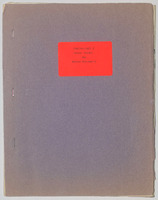 Chronicles I, Prose Poems by Anita Cornwell
 Anita Cornwell (1923 - 2023). The document opens with a dedication to Cornwell’s mother and a short biography highlighting her career as a writer and playwright, followed by the table of contents that lists five poems.
They are:
1. First Love and Other Traumas
2. Second Coming
3. Sordid Mansions
4. In Praise of the Foremothers
5. Remembrance of Sister-Love
-
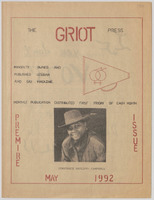 The Griot Press, premiere issue (May 1992)
 The Griot Press was a minority owned and published lesbian and gay magazine.
-
 Memorial collage of Jaci Adams photographs / typed biography of Jaci Adams
 This memorial collage of Jaci DuBoise Adams features eight overlapping color photographs– two of Adams alone smiling, and the remaining of Adams smiling in small groups of people. On the back of the frame is a biography of Adams’ life, highlighting her resilience, many accomplishments, and relentless leadership and advocacy for the Philadelphia trans community and HIV/AIDS issues.
-
 Council of the City of Philadelphia, Resolution Honoring the Rich Life and Loving Memory of Jaci Adams
 Honoring Jaci Adams: A Legacy of Advocacy and Leadership
Jaci Adams (1956 - 2014) was a remarkable transwoman whose life embodied resilience and the "American Dream." Born in Beckley, WV., and raised in North Philadelphia, Adams overcame a history of abuse, addiction, and incarceration to become a fierce advocate for social justice, particularly for the trans community. (AIDS Law Project of Philadelphia, “In Memoriam: Our Beloved Jaci Adams.”)
-
 Tribute to Jaci Duboise Adams
 This tribute was written by City of Philadelphia Mayor Michael A. Nutter on March 21, 2014 to honor the life and legacy of Jaci DuBoise Adams, a leader, advocate, and educator in the Philadelphia LGBT community.
-
 Commonwealth of Pennsylvania, The House of Representatives, Condolence Resolution
 Condolence resolution in honor of Jaci Adams (1956 - 2014).
Jaci DuBoise Adams (1958-February 15, 2014) was born in Beckley, West Virginia and moved to Philadelphia in her youth with her family. Unfortunately Adams experienced such abuse that she “fled the house in search of safety” at age nine. Adams was “soon consumed by a life of prostitution, drug abuse and crime while searching for an identity”. She landed in prison, and earned her GED. (AIDS Law Project, “More than 300 People Attend Memorial Service for Jaci Adams.”)
In 2002 after the unsolved murder of Nizah Morris, a 47 year old transgender entertainer that was found brutally beaten at 15th and Walnut Streets in Philadelphia, Adams shared that she had “an ‘a-ha’ moment and decided that instead of being angry, maybe a career criminal like [her] could use that familiarity with the cops to slither in and become part of the solution” (Philadelphia Inquirer, “Jaci Adams, 56, Inspirational LGBT Leader.”). Known to be genuine, accomplished yet immensely humble, to speak and teach from her vast life experience, and incredibly kind, Adams was held in high regard by many– from city officials such as Michael Nutter, to long-time friends, to folks she just met and was lending support to (AIDS Law Project, “More than 300 People Attend Memorial Service for Jaci Adams.”).
-
 Philadelphia Police Department Certificate of Appreciation presented to Jaci Adams
 This recognition was posthumously awarded to Jaci Adams for her service on the LGBT Police Liaison Committee of which Adams was the longest serving member.
Jaci (pronounced "Jackie") Adams was born in 1957/1958 in Beckley, West Virginia. She died on February 16, 2014.
Adams was a transgender woman active in LGBT and AIDS programs. Diagnosed with AIDS in 1983, Adams worked to promote AIDS testing and treatment, and worked to help people harmed by discrimination, homelessness, incarceration, poverty, prostitution, and drug addictions.
Adams obituary in the Philadelphia Daily News on February 17, 2014 stated the following: "...Jaci was able to shed light into the darkness that often shrouds the frequently misunderstood and abused dwellers of the LGBT world."
-
 Gospel Pearls, songbook
 Handwritten inscription of "J. R. Coleman" inside front cover.
Gospel Pearls, first published in 1921, was a hymnal that includes a combination of African American spirtuals and traditional hymns. It was commonly used in churches, but also at religious conventions and revival meetings. Gospel Pearls played an important role in standarizing gospel music in African American churches. The inscription "JR Coleman" was for John Robert Coleman, grandfather of Elaine Buck. Buck is a co-founder of the Stoutsburg Sourland African American Museum, established in 2016 in the historic Mt. Zion AME Church in Skillman, New Jersey.
-
 Gospel Songs and Spiritual Poetic Poem Book
 The book “Gospel Songs and Spiritual Poetic Poem Book” by Rev. J. F. Hamlette has four parts and is 56 pages. It has handwritten inscriptions of Ada and George Hightower's names on cover and inside, who were members of the First Colored Church in Hopewell, NJ and were among the first African Americans to live on Columbia Avenue in Hopewell.
-
 Bethel African Methodist Episcopal Church Sunday School
 This photograph of the Bethel African Methodist Episopal Church Sunday School of Pennington, NJ features nineteen children, some siblings. All of the children in the photograph have been identified by Patricia (née True) Payne (see reverse).
-
 Photograph of Earl's All Girl Chorus
 Earl Hubbard’s All‑Girl Chorus was a community-based chorus directed by William Earl Hubbard (1908-2002). The Chorus was noted as singing at a Historical Pageant celebrating Pennington, NJ (Pennington Sesquibicentennial 250th Booklet, 1958).
-
 Song Lyrics, Handwritten
 Song lyrics noted by Jean Smith, a member of Earl's All-Girl Chorus, a Pennington singing group directed by William Earl Hubbard. The lyrics show the repertoire for the chorus and include both religious and gospel songs. 94 sheets of loose paper with handwritten song lyrics, mid-20th century.
-
 Moses Truehart and Eliza Truehart - charcoal drawing, framed (replaced tintype of Corinda) - 2' x 3'
 This charcoal drawing is of Moses Truehart and Eliza Truehart, a married couple with deep roots in the Sourland Mountain region of New Jersey.
-
 Letter by Garland Fields Sr. to Emeline Gillette, with envelope and fragments
 Garland Fields Sr. (1897 - 1974) was the grandfather of Beverly Mills (b. 1960). Mills is one of the co-founders of the Stoutsburg Sourland African American Museum with Elaine Buck. The two co-authored the books noted below.
-
 Handwritten Stoutsburg Cemetery Ledger
 This handwritten ledger was kept by Herbert Albert Hubbard (June 7, 1875-July 11, 1948), Beverly Mills's (co-founder of the Stoutsburg Sourland African American Museum) great-grandfather, at the Stoutsburg Cemetery. It includes minutes from Stoutsburg Cemetery Association meetings, including hymns sung and fundraising efforts, from 1912 through the 1920s.
-
 Starr Standing Victrola
 Originally belonged to the Smith brothers (Alfonso, Clarence, Raymond, and Leon), who were born in Neshanic Station to Joseph Smith Jr. and Cora Smith of Pennington. The brothers pooled their money to purchase the Victrola for their family's enjoyment. Beverly Mills, co-founder of SSAAM, is a Smith family descendant.
-
 Organ at Mt. Zion African Methodist Episcopal Church
 Pump organ, pre-1917. Made by the Cornish Company in Washington, NJ, which ceased organ production around 1922. The organ was played at the First Baptist Church in Pennington.
-
 Group of 1930's - 1940's Church Hats
 Church hats that would have been worn by the ladies of Mt. Zion AME Church in the late 20th century.
-
 Four Aprons
 Sewn for 10 cents each by ladies of Bethel African Methodist Episcopal (AME) Church in Pennington, NJ as a fundraiser. The donor, Constance Driver Wheeler, remembers her mother, Helen, and other ladies of the church sewing the aprons in their home.
-
 Wooden collection boxes (two)
 Original to Bethel African Methodist Episcopal (AME) Church. A booklet printed in 1966 in honor of the church’s 150th anniversary says: “Two of the original collection boxes are prize possessions of the church and are still used on special occasions.” On loan to the Stoutsburg Sourland African American Museum (SSAAM) from the members of Bethel AME Church in Pennington, NJ
-
 Toy Violin and Case
 Handmade child's violin and instrument case, late-20th century. Built by William Earl Hubbard (1908-2002), a self-taught violinist and music teacher, for his niece Danielle Thompson.
-
 Milk glass chalice (fragment)
 Milk glass chalice c. 20th century.
-
 Paper and rattan church hand fans, 6 fans, 11 sides (Front View)
 A sampling of paper and rattan hand fans, mid-20th century. The fans have religious imagery on the front and advertisements for funeral home services on the reverse. Church fans used at Mt. Zion African Methodist Episcopal (AME) Church.
-
 Billy Truehart milkbox
 "Billy Truehart's milk box," early 20th century. Handmade wooden box with metal letters on three sliding lids and nail heads within each compartment. Made by William "Billy" Truehart, grandson of Friday Truehart, while working as a handyman for the Blackwell family in Trenton, NJ.
-
 Woven peach basket, early-20th century.
 This woven peach basket was manufactured in the early 1900s by African American workers in the Sourland Mountain peach orchards, a large employer for the local Black community, according to the Stoutsburg Sourland African American Museum. Peach baskets were used to collect peaches during harvest, until the San Jose scale peach blight occurred in the late 1800s.
-
 Mt. Zion African Methodist Episcopal Church (structure)
 Mt. Zion African Methodist Episcopal Church, built in 1899
-
 Invitation to Testimonial Dinner to Charles S. Johnson, illustrated by Aaron Douglas.
 Illustration created by Aaron Douglas in Philadelphia for an invitation to Testimonial Dinner for Charles S. Johnson in New York, NY.
-
 “Meet the Hinksons.”
 “Meet the Hinksons of Philadelphia, Penna.” is a six-page magazine article published in the Ladies’ Home Journal series “How America Lives” in August 1942. The article highlights the everyday life of the Hinkson family, including education, careers, fashion, travel, and home, and the impact of various wars on their lives.
-
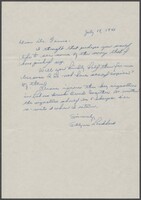 Letter and sheet music. Ablyne Lockhart to Albert C. Barnes, July 14, 1943.
 Lockhart's handwritten letter and sheet music based on spirituals mailed to Barnes
-
 Program for recital at Ethical Society Auditorium.
 Lockhart's program for recital at Ethical Society Auditorium
-
 Letter. Paul B. Moses to Violette de Mazia
 This correspondence from Paul Moses to Violette de Mazia on January 21, 1951 details an acceptance from Moses to begin teaching art appreciation for Lincoln University students at the Barnes Foundation.
-
 Photograph. Paul B. Moses with his painting Ice House
 Paul B. Moses (1929 - 1966) was born in Ardmore, Pennsylvania, attended Lower Merion High School and became one of the first Black undergraduates at Haverford College. Despite facing racism and isolation, he excelled in languages and art, studying abroad in France with the support of Albert C. Barnes, MD. After serving in the U.S. Army, he taught at institutions including the Barnes Foundation, Lincoln University, and at the American Overseas School in Rome before earning a Masters and pursuing a doctorate in art history at Harvard, where his dissertation specialized in Degas’s etchings (Haverford College, 2023).
-
 Postcard. Paul B. Moses to Violette de Mazia
 About 1950, Paul Moses wrote to Violette de Mazia from Europe, joking he once paid for lodging in Venice with a 33⅓ record. Traveling with Philadelphia friends through Capri, Florence, and Venice, he calls Capri the most beautiful place he has seen and looks forward to studying the French Primitives, which refers to the book "French Primitives and their Forms" by Albert C. Barnes and Violette de Mazia, which Moses says he will use as his guide. [https://archive.org/details/frenchprimitives00barn]
-
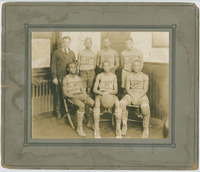 [African American basketball team]
 This photograph is a group portrait depicting members of an African American basketball team with their coach, likely in Philadelphia, taken in or around 1920.
-
 Base-ball-to-day Philadelphia Giants the fastest colored team in base ball vs Dixfield A.A.
 A handbill for a baseball game between the Philadelphia Giants and the Dixfield A.A.
Formed in 1902, the Philadelphia Giants were a powerhouse independent Black team until disbanding in 1911, a move forced by player defections (Brack, 2025).
-
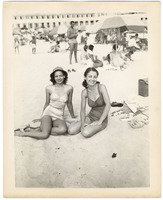 Georgine E. Upshur Willis and Marie Christmas Harris in Atlantic City
 Photograph of Georgine E. Upshur Willis and Marie Christmas Harris in Atlantic City, NJ.
Since the beaches at Atlantic City were segregated at this time, we assume that Willis and Harris were at Chicken Bone Beach.
Chicken Bone Beach was the segregated section for African Americans on Atlantic City's beach area. Between 1900 and the early 1950s, African Americans were socially restricted to use the Missouri Avenue Beach Area.
Since many vacationing Black families arrived with chicken-laden hampers, the strip became affectionately named "Chicken Bone Beach."
-
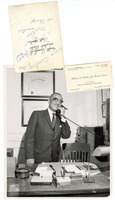 William A. Upshur, Jr. on the phone.
 A black and white photograph taken by John W. Mosley (1907-1969) featuring William Arthur Upshur Jr. (1894-1963) on the phone at his office desk. His business card for his funeral home is stapled to the photo. Another photo flipped right side down sits above. It has handwritten inscriptions.
-
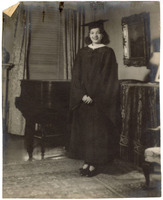 Georgine E. Upshur [Willis], 1943 University of Pennsylvania Graduation
 This photograph features Georgine Elizabeth (née Upshur) Willis posing for her graduation from the University of Pennsylvania in 1943.
-
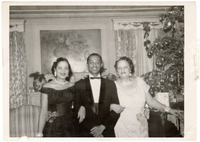 Georgine Upshur Willis, William Willis, and Agnes Saunders Chew Upshur in formal attire during Christmas holiday
 A black and white photograph featuring Georgine Upshur Willis (1921-1998), her husband William Shedrick Willis, Jr., (1921-1983) and her mother Agnes Saunders Chew Upshur (1896-1924) in formal attire during the Christmas holiday.
-
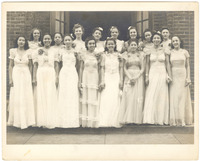 Gene's [Georgine E. Upshur [Willis]] Coming Out Party
 This photograph features Georgine “Gene” Elizabeth Upshur Willis and 15 other graduates of Philadelphia High School for Girls in June 1939. They are smiling and dressed up.
-
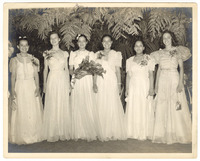 High School "Coming Out Party" for Gene [Georgine E. Upshur [Willis]] 1939 given by her parents Agnes & William A. Upshur, Jr.
 Photograph of Georgine E. Upshur Willis' Coming Out Party
-
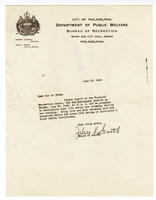 Letter addressed to “Sir or Madam” from the City of Philadelphia Department of Public Welfare, Bureau of Recreation about reporting to Funfield Recreation Center “to demonstrate your life saving and swimming ability and training,” June 18, 1942
 Since this letter came from the collections of Georgine Upshur Willis, we assume that she received this letter asking her to try out to be a lifeguard at the Funfield Recreation Center from the Department of Public Welfare, Bureau of Recreation in 1942.
The Funfield Recreation Center was located at 22nd and Sedgley Street. The center, which was built in 1916, was designed by the architect Philip H. Johnson (1868-1933), who served as the architect for the Philadelphia City Department of Public Health.
-
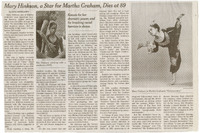 Mary Hinkson news clipping
 News clipping about the passing of Mary Hinkson, one of two of the first Black dancers with Martha Graham Dance Company.
-
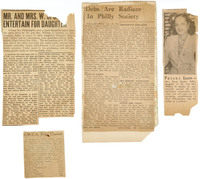 Mrs. Gene Upshur Willis news clippings
 This collection of news clippings are about are about Georgine Upshur's achievements, including: a Y.W.C.A. baby contest, her Philadelphia High School for Girls graduation and coming out parties, and passing of the state mortician’s exam circa 1949.
-
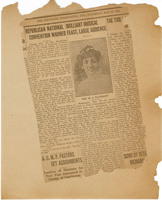 Mrs. M. S. Patterson annual event news clipping
 News clipping about dance recital, "The Unveiling of Spring".
Mary Emma Saunders Patterson (1872 - 1950) was known beyond Philadelphia's church circles and musical societies. Patterson had cultivated a reputation for nurturing young voices with precision and discipline.
-
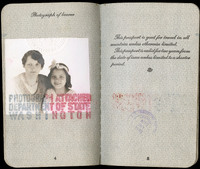 Passport photograph of Agnes Upshur and Georgine Upshur
 An insert from Agnes Upshur’s (1896-1984) day journal “My Trip Abroad.” The insert features her passport with a photograph of her and her young daughter Georgine Elizabeth Upshur.
-
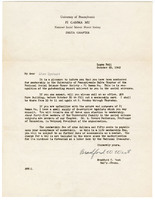 Letter to Georgine Upshur informing her of her nomination for membership in the University of Pennsylvania Delta Chapter of the National Social Science Honor Society – Pi Gamma Mu, October 23, 1942
 This letter was sent to Miss Georgine “Gene” Elizabeth Upshur on October 23, 1942 from Pi Gamma Mu, the National Social Science Honor Society’s Delta Chapter at the University of Pennsylvania notifying her of her nomination for membership. The daughter of a prominent, affluent Philadelphia African American family, Gene became an undertaker like her father.
-
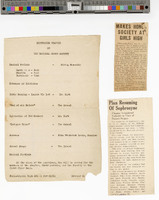 National Honor Society news clippings
 A 1938 news clipping about Georgine E. Upshur being nominated and elected to the honor society at the Philadelphia High School for Girls. Upshur was the second colored girl in the school's history to be nominated.
-
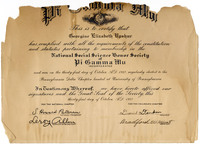 Pi Gamma Mu certificate issued to Georgine Elizabeth Upshur, October 31, 1942
 A certificate verifying Georgine Elizabeth Upshur’s membership in Pennsylvania University’s Delta Chapter of the National Social Science Honor Society of Pi Gamma Mu. The certificate is damaged at the top.
More information is available in the annotation of the document.
-
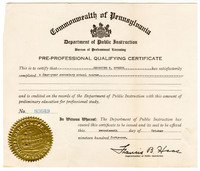 Commonwealth of Pennsylvania Department of Public Instruction Bureau of Professional Licensing Pre-Professional Qualifying Certificate
 This certificate from the Commonwealth of Pennsylvania Department of Public Instruction’s Bureau of Professional Licensing Pre-Professional Qualifying Certificate was granted to Georgine E. Upshur for completion of a four-year secondary school course in 1941. This was a modified certificate given to Black educators.
-
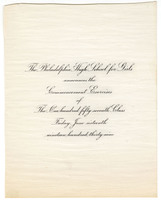 The Philadelphia High School for Girls commencement announcement
 The 157th Graduating Class: June 16, 1939. The Girls Normal School, aka, Philadelphia High School for Girls was established in 1848 as the first publicly supported high school for girls in Pennsylvania (The Alumnae Association of the Philadelphia High School for Girls, 2025).
-
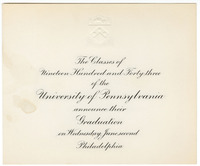 Invitation to the graduation of the University of Pennsylvania classes of 1943
 This invitation card is part of a collection that also includes “Diary of the Women of the Class of 1943, University of Pennsylvania, The 1943 Almanack” containing inserts of correspondence, documents, and programs related to Georgine E. Upshur’s college education at University of Pennsylvania.
Georgine Elizabeth Upshur-Willis (September 3, 1921-December 30, 1998) was born to William Arthur Upshur Jr. (January 8, 1984-May 5, 1963) and Agnes (née Chew) Upshur (1896-June 28, 1984). The Upshurs were a prominent, affluent African-American family with connections in Philadelphia politics, community, education, and culture. Georgine Upshur became a licensed mortician and planned to join her father as partner in his business. Her father ran a funeral home (“The William A. Upshur Funeral Home” at 21st and Christian Street) in addition to being a recording secretary for the Republican City Committee, republican leader of the 30th ward, a member of the NAACP and Urban League, and an active alumni member of the University of Pennsylvania. Georgine married Dr. William Shedrick Willis Jr. (July 11, 1921-August 8, 1983) in 1949.
-
 Invitation to the wedding of Cordelia Sanders Chew and Dr. Dehaven Hinkson
 Wedding reception invitation for marriage between Cordelia Sanders Chew and Dr. DeHaven Hinkson.